
Home › Commercial › Apartment and Property Manager Mold Remediation in Lafayette, LA
Apartment and Property Manager Mold Remediation in Lafayette, LA
Mold in one unit can come from a leak in another. Here is how property managers handle mold across apartments and rentals.
- Multiple units
- Tenants
- Recurring leaks
- Records
What should a property manager do about mold in an apartment?
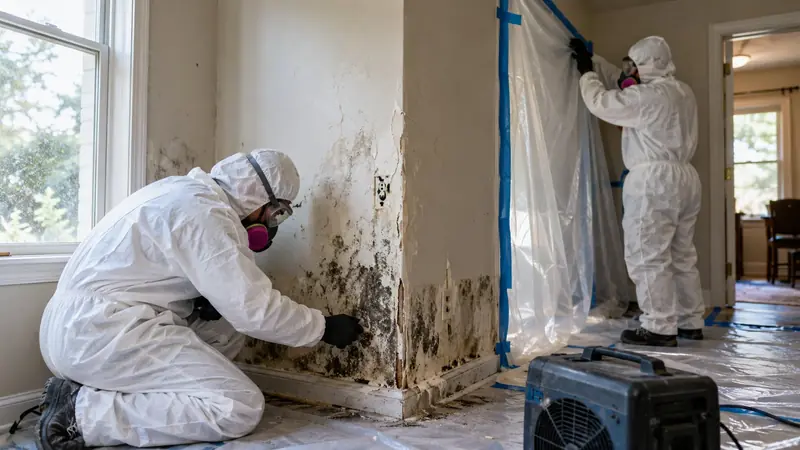
Respond promptly in writing, find the water source, check adjacent units, remove contaminated materials with proper containment, dry the structure and keep a written report. Use a licensed remediator when the work exceeds $7,500, and keep tenants informed.
A response checklist
Acknowledge
Respond in writing quickly.
Find the source
Check plumbing, roof, windows and AC condensate.
Check neighbors
Look above, below and beside the unit.
Scope and remediate
Written scope, containment and removal.
Document
Photos, report and invoices.
Risks of delay
- Mold spreads and damage grows
- Tenant health complaints
- Disputes and legal exposure
- Higher repair costs
See mold in a rental for the tenant side and Louisiana mold laws for licensing.
Working with us
Call (337) 895-1030. See commercial mold remediation, mold after water damage and mold and insurance claims. Call (337) 895-1030 — property manager? request a quote and we will scope every unit.
The math a property manager actually runs
A homeowner asks “what will this cost.” A property manager asks “how many rent-days does this cost me.” A unit sitting vacant with the windows open and a dehumidifier running is the most expensive remediation there is — every empty day is lost rent on top of the repair bill. That’s why multifamily mold work is scheduled like a turnover, not a project: assess fast, contain the single unit, fix the moisture source, remediate, verify, and get it back to leasing. Phased work keeps the rest of the building rentable — occupied units stay occupied while one unit is under containment. And one vendor handling assessment through clearance beats three vendors handing off: fewer coordination gaps, one documentation file per unit, one phone number when the next unit calls with the same complaint. Speed here isn’t rushing; it’s a sequence planned before the first tool comes out.
Tenant complaints and Louisiana landlord exposure
Nothing escalates like a tenant who reported mold twice and heard nothing. Louisiana landlords have real exposure for known, unaddressed conditions — and the paper trail (or the absence of one) is what decides those disputes. The professional standard is simple: log every complaint with a date, inspect promptly, photograph and moisture-test what you find, and keep the written scope and clearance record per unit. That file does three jobs at once: it shows the tenant the problem was taken seriously, it supports any insurance claim, and it documents due diligence if a dispute ever reaches a lawyer’s desk. Respond fast, document everything, and never put “we’ll get to it” in writing without a date attached. For questions about tenant and landlord rights specifically, our Louisiana mold laws guide walks through the state framework — but the operational rule never changes: speed plus paperwork.
The repeat offenders in Acadiana multifamily buildings
Multifamily buildings fail in the same places, unit after unit. Stacked plumbing: a slow supply-line or drain leak on the third floor shows up as a ceiling stain on the first, and by the time it’s visible three units are affected. AC condensate lines: every unit’s line clogs at some point each cooling season in this humidity, dripping inside walls until someone smells it. Slab-edge intrusion: ground-floor units take water at the slab edge every heavy rain season, and carpet over concrete holds it for weeks. Laundry rooms and exterior breezeway-adjacent walls: constant moisture load plus poor drying equals chronic growth. When the third unit in a building shows the same pattern, stop treating units and assess the building system — the fix is usually one plumbing or drainage correction plus remediation, not five separate cleanups.
Frequently asked questions
Can one unit affect another?
Yes. Leaks and humidity travel through shared walls and floors.
Should I test every unit?
Not necessarily. Start with moisture findings.
How do I document?
Dated photos, written notices and the final report.
Do you handle multiple units?
Call and describe the property.
Can tenants stay in the building during remediation?
Yes — that’s the point of unit-level containment. Only the affected unit is sealed off; neighboring units stay occupied. Whole-building evacuation is essentially never needed for mold work.
How fast can a unit turn around?
A single-unit remediation typically resolves within days once the moisture source is fixed — but the source has to be found first, which is what the assessment is for. We schedule like a turnover because that’s what it is.
Who pays — owner or tenant?
It depends on the lease and the cause, and Louisiana’s framework is covered in our mold laws guide. Operationally: document the cause carefully, because “tenant lifestyle moisture” and “building system failure” lead to very different conversations.
Keep reading
Commercial mold remediation
Hotels, apartments, healthcare and more.
Mold in a rental
Tenant and landlord steps.
Mold and insurance claims
What policies usually cover and how to document.
Lafayette, Louisiana
Talk to a Lafayette mold remediation crew
Call and tell us what you are seeing: where it is, how long the area has been wet and how big it looks. We will tell you plainly whether it sounds like a job for a crew or something you can handle yourself.