Home › Remediation Process
How Mold Remediation Works in Lafayette, LA
Containment, removal, cleaning and drying done in the right order, with the moisture source fixed so the mold stays gone. Call (337) 895-1030 and tell us what you are seeing.
- Containment
- HEPA filtration
- Moisture source first
- Written report
What is mold remediation?
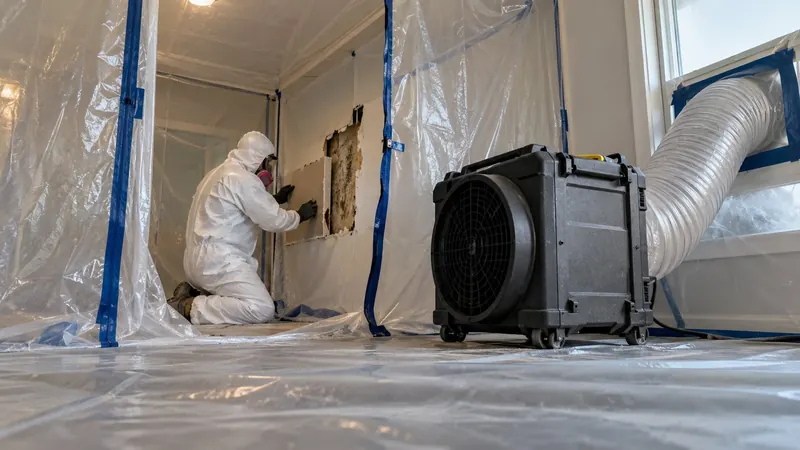
Mold remediation is the controlled process of finding the moisture source, containing the affected area, removing materials that cannot be saved, cleaning what can, drying everything and confirming the job is finished. The goal is not to kill mold. It is to remove it and stop it from coming back.
What a proper remediation job includes
Every job is different, but the order matters. Cleaning first and fixing the leak later is how mold returns. A job that follows EPA-style practice looks like this:
Find the water
Locate and stop the moisture source: a roof leak, plumbing, condensation, flooding or high humidity.
Inspect and scope
Map the affected areas, including hidden spots behind walls, under floors and in the attic, and write down what will be removed.
Contain
Seal the work area with plastic sheeting so spores do not spread to the rest of the house.
Filter the air
Run HEPA air filtration, with negative air pressure where the job calls for it.
Remove
Take out porous materials that cannot be cleaned, such as wet drywall, insulation and carpet pad, bagging them in the work area.
Clean
HEPA vacuum and damp wipe salvageable surfaces such as framing and hard materials.
Dry
Bring materials back to normal moisture levels and confirm with a meter. EPA guidance is to dry within 24 to 48 hours of a wetting event.
Check and document
Do a final visual and moisture check and provide a written report. Louisiana requires one for paid remediation.
When to call a crew instead of handling it yourself
- The mold covers more than about 10 square feet, the EPA’s usual dividing line for small homeowner jobs.
- It came back after you cleaned it.
- The cause was a flood, a sewage backup or other contaminated water.
- It is in or near the HVAC system or ductwork.
- You can smell it but cannot find it, which often means it is inside a wall, ceiling or crawl space.
- Someone in the home has asthma, allergies, a weakened immune system or is very young or elderly.
If your situation is a small patch on a hard surface, our guide on mold removal and what you can do yourself walks through it safely.
Why Lafayette homes get mold
Mold needs moisture, something to eat and time. Acadiana provides moisture most of the year: Gulf humidity, heavy rain, a high water table and air conditioners that run for months. Here is where we most often see growth in Lafayette-area homes.
| Where | Common cause |
|---|---|
| Attic | Roof leaks, poor ventilation, bathroom fans venting into the attic. |
| Bathrooms | Weak exhaust fans, shower moisture, leaks behind tile or under vanities. |
| Laundry rooms | Supply line leaks, washer overflows, trapped humidity. |
| Walls and ceilings | Plumbing leaks, window leaks, condensation on cold surfaces. |
| Ducts and air handlers | Condensation and dirty drain pans. |
| Crawl spaces and pier-and-beam | Ground moisture and poor ventilation. |
| After flooding | Wet drywall, insulation and flooring left too long. Aug 2016 flooding showed how quickly this goes wrong in Acadiana. |
What Louisiana law says about remediation
Louisiana requires a mold remediation license from the LSLBC for work costing more than $7,500, with 24 hours of board-approved training, and a written report for paid remediation. A remediator cannot also assess the same property. From August 1, 2026 the minimum liability insurance is $500,000. Owners and tenants can work on their own property without a license.
Full details: Louisiana mold laws. Before you hire, read our guide to hiring a mold remediation company.
Areas we serve
Central Lafayette (ZIP codes 70501, 70503, 70506, 70507 and 70508), Broussard (70518), Youngsville (70592), Scott (70583) and Carencro (70520). Our office is at 1026 SW Evangeline Thruway, Lafayette, LA 70501. We provide mold remediation Lafayette, LA homeowners rely on, with a written report on every job.
Related guides: what mold remediation costs, mold inspection and testing and mold after a flood.
Frequently asked questions
What is the difference between mold remediation and mold removal?
Remediation is the whole process: fix the moisture, contain, remove, clean, dry and verify. Removal is one part of it, taking out contaminated material. We explain the practical differences on our mold removal page.
How long does mold remediation take?
Small, contained jobs can take a day or two. Larger jobs, or jobs with hidden damage and drying time, take longer. The scope and the drying are what drive the schedule.
Do I have to leave my house during remediation?
Often not, if the work area is properly contained, but it depends on the size and location. Ask your company. People with asthma, allergies or weakened immune systems should talk to their doctor.
Will bleach fix the mold?
The EPA does not recommend routine bleach use. Mold has to be removed, not just killed, and bleach is not effective on porous materials. Never mix bleach with ammonia.
Will mold come back after remediation?
Not if the moisture problem is fixed and the area is dried. Mold returns when the water source or high humidity is still there.
Does insurance pay for mold remediation?
Sometimes. Coverage depends on your policy and the cause of the water. Flooding is generally excluded from standard homeowners policies. Read your policy and ask your agent.
Keep reading
Mold removal in Lafayette
What gets removed and what you can do yourself.
Mold remediation cost
What drives the price.
Mold after a flood
The first 48 hours.
Lafayette, Louisiana
Talk to a Lafayette mold remediation crew
Call and tell us what you are seeing: where it is, how long the area has been wet, and how big it looks. We will tell you plainly whether it sounds like a job for a crew or something you can handle yourself. See how we work from first call to final report.